

On August 31, the J-PARC Center, Nagoya University, and four other universities and research institutions issued a joint press release announcing the successful acceleration of cooled muons to 0.3 MeV at the Materials and Life Science Experimental Facility (MLF) of the Japan Proton Accelerator Research Complex (J-PARC).
In this acceleration test, muons were successfully cooled from a kinetic energy of 4 MeV to 25 meV and then accelerated to 0.3 MeV. Compared with the world's first demonstration experiment of muon cooling and acceleration conducted in 2024, the acceleration energy was increased threefold, from 0.1 MeV to 0.3 MeV, while the muon beam intensity increased approximately 200 times, from 0.05 muons per second to approximately 10 muons per second. Furthermore, in this acceleration test, the cooling and acceleration of muons were performed in the newly established experimental area dedicated to muon acceleration (H2 area), using the actual equipment intended for use in the muon \(g-2\)/EDM experiment.
At N-lab, we are developing and operating muon beam monitors and analyzing the data obtained from them toward the realization of a muon accelerator. In this acceleration test, we introduced a beam diagnostic system using high-time-resolution detectors, contributing to a detailed understanding of beam characteristics, including the time structure of the accelerated muon beam. We also contributed to the setup of the equipment and data acquisition during the cooling and acceleration test. Prof. Toru Iijima, Assoc. Prof. Kenji Inami, Designated Assoc. Prof. Kazuhito Suzuki (KMI), Designated Assistant Prof. Yusuke Takeuchi, Ayaka Kondo (D1), and Koki Hirai (M2) contributed to this research.
We will continue to develop the muon accelerator, aiming to accelerate muons to 4 MeV around 2027–2028. In the future, we aim to accelerate muons to 200 MeV or higher and further develop the accelerator for various research applications, including precision measurements of the muon anomalous magnetic moment (\(g-2\)) and electric dipole moment (EDM), as well as transmission muon microscopy.
For more details, please refer to the joint press release.
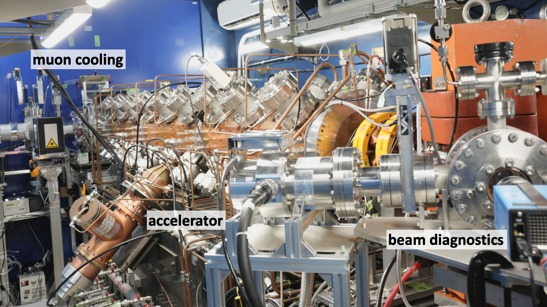
Muon cooling, acceleration, and beam diagnostic systems installed in the H2 area
